SORRENTO

Sorrento on the southwest tip of the Bay of Naples sits on old ground, which is to say you can find steps and bits of wall there that the Greeks constructed in the fifth century BC. The name Sorrento may come from the Greek word for the sirens Homer described in the Odyssey. It is famous for its lemons and its proximity to spectacular sights such as Pompeii, Herculaneum, the island of Capri, the Amalfi coast and of course Naples itself. If you enjoy NASCAR you could spend all of your time in Sorrento just watching the traffic. Nowhere in Italy did we find young men and women on motor scooters so adept and daring. If the law of averages applied in Sorrento, the Via Capo would be littered with bodies and trashed vehicles.

We arrived at the Naples airport midday on a Monday early in May, having flown from Frankfurt with a change in Munich. The good folks at Hotel Desiree (more a B&B than a hotel) had emailed the correct bus number that would take us to Sorrento and we found it waiting dutifully outside. The driver was a handsome, unflappable fellow with the requisite aviator shades and the butt of a cigar that he never lit and that never left his mouth. His driving would make a choreographer jealous. As usual, it was just the three of us: Nina, myself and Rick Steves (in book form). Rick speaks volumes but only when asked, and he does it quietly and with good humor.

That night Rick suggested we eat at the Ristorante Delfino which is located as one might suspect at the end of something, in this case at the end of the pier on Marina Grande, which according to the map seemed to be almost directly below our highly perched bed and breakfast. Unfortunately, as we learned, there was no direct route from our room to the restaurant though there were several indirect wrong ones, a couple of which we tried.

As anyone who has traveled on one’s own in a foreign country can testify, one of the constants is that you are almost always doing things for the first time while struggling with customs and languages that are unfamiliar. As a result you accomplish little and are often lost and confused. The benefit is that a simple accomplishment, like locating a restaurant at the end of a pier, finding it open and being led to a table by a welcoming host, brings an absurd rush of pleasure.

In this case, the family of owners was entertaining, the food and ambiance wonderful. We shared an antipasto of mussels and clams drenched in garlic followed by a grilled sea bass that a young man in black slacks, a white shirt and a black apron carefully and proudly filleted at our table. Because we had Rick along we each received a complementary and delicious limoncello, a liquor served chilled and made from the famous (and huge) local lemons. Last came the obligatory chocolate, coffee and hazelnut gelato (we were in Italy after all). As we were leaving the mother who took our Euros slid into our palms small metal images depicting the Virgin Mary (we were in Italy after all).

On our long climb back to the hotel we bought a bottle of red wine for 28 Euros and a small bottle of the mysterious limoncello to take to our room. The wine was the most expensive and the worst tasting of any we had in Europe and the liquor disgustingly sweet. How could that stuff at the restaurant have been so delicious and this so awful? Still lost and confused.

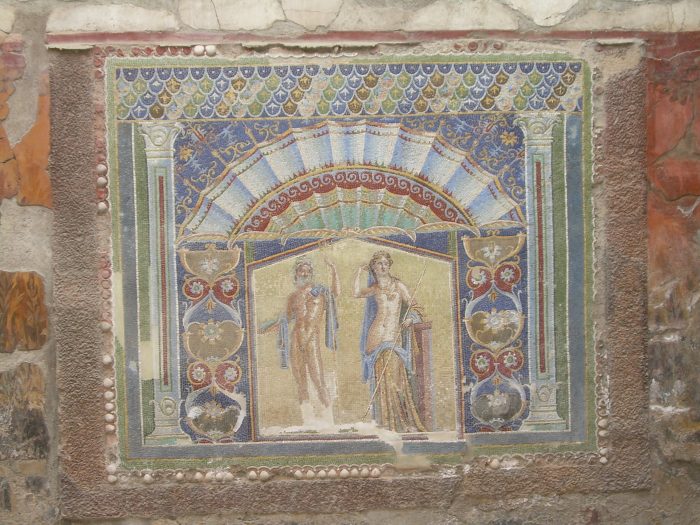
Photo of art on a wall in Herculaneum
POMPEII WALL ART

Posted in Travel | | Tagged , , | | Leave a comment

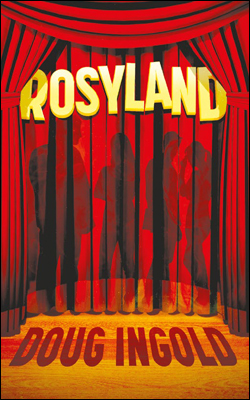
Rosyland: A Novel in III Acts

Rosyland: A Novel in III Acts by Doug Ingold

Two actors commit adultery, a rogue cop torments a criminal, a lawyer and a costume designer feel betrayed, two mothers worry about their daughters. And festering beneath the surface is one man’s craving for revenge. As children Elisa and Janet were neighbors and best friends. Today only one thing connects them: the hatred one father has for the other.

Reviews:

“Ingold’s narrative is laid out like a movie or stage play, and its shifts from scene to scene are effortless. He maintains the easy flow of each character’s separate plotline until they all tie neatly together….A skillfully written novel with plenty of intrigue, plot twists, and romance.”


Read on

Posted in Novels | | Tagged | | Leave a comment

SCENES FROM PARIS

SCENES FROM PARIS (June 10-14, 2016)

In the Musee D’Orsay, home of the world’s greatest collection of impressionistic art, hundreds of people cluster close to the famous paintings by Monet, Manet, Degas, Van Gogh, etc. Rather than actually looking at the paintings, a surprising number of them pause only long enough to take a photo on their phone or ipad before moving on to the next one. The desire, it seems, is not to actually experience the painting but to possess it in some way.

The Euro 2016 Soccer Championships are being held in France. Twenty-four teams from Iceland to Turkey are competing in ten venues throughout the country. The games begin the day we arrive. Crowds of fans have come from all over Europe, the Swedes in their bright yellow, the Irish in their bright green, the Croatians in red and white check are drinking beer at outside tables, chanting and singing songs. My God, we realize, the Irish over there are singing “Amazing Grace!”

At Sacre Coeur at the top of Montmartre on Sunday morning the seats are all taken during mass. A chorus of nuns in white with black trim sing while priests in green and white robes perform the liturgy of Eucharist and the congregation stands and sits and kneels oblivious to the thick stream of tourists who are entering through the doors on the left, passing slowly counter-clockwise around and behind the ceremony snapping photos before exiting through the doors on the right.

Descending from Montmartre we find a building where Vincent Van Gogh lived with his brother Theo for a couple of years in the 1880s. Hoping to find a painting he may have forgotten in a corner, I knock on the huge blue door. No one answers but as I am standing there a woman comes up the street. She pulls out a key, opens the door, smiles at the old kook standing beside her, goes inside, closes and locks the door.

Hundreds of locals ride the ubiquitous gray-brown rental bikes that you can pick up and leave off at many convenient locations. There are traffic lights for bicycles and everyone seems to obey the rules.

Seated at an outside table on rue Montorqueil having a class of wine while enjoying the passing scene we note particularly the two ladies sitting a couple of tables away smoking cigarettes, drinking wine and looking tres chic with their nifty scarves. How Parisian they are! When we finely get up to leave one of them asks, “So, where y’all from?” They being from North Carolina and Virginia.

On the pedestrian-only Pont des Arts amid a group of striking metallic sculptures set on long pallets a man is playing the classic shell game. He throws a cloth on the pavement, squats down with three shells one of which has a bean beneath it. A crowd of men and women gather. He moves the shells around very quickly and as I watch I can see how he deftly moves the bean from one shell to the other. When he stops, men place a foot on the shell they think contains the bean. They bet and lose. But from my angle I can tell which shell holds the bean. Suddenly the man looks over at me. He hands me a fifty Euro note and asks me to bet. A woman in the group yells with broken English, “Show your money!” The other gamblers are watching me. I realize now that I am the mark. To get me into the game, the man has been deliberately showing me which shell has the bean. Just then a police car pulls up at the corner. The man grabs back the fifty Euros, scoops up his cloth, his shells and his bean and disappears into the crowd. Moments later he is at work again halfway across the bridge.

At the Church of St. Eustache on Saturday evening, we attend a concert put on by the Iranian immigrant community. An orchestra and choir made up of Iranian and native Parisian students perform newly composed Iranian music to a packed house. Between the numbers long speeches are given that are unintelligible to us. Outside, at the back of the church we notice some construction going on in the middle of the street. Early the next morning when we walk back, we find a street market in full bloom with breads, vegetables, fruits, cheeses and long tables stacked with fish and other seafood. We buy olives, tomatoes, berries, cheese.

Everywhere we went in Europe the tap water was drinkable, though in many places the restaurants sell mineral water as a matter of course. Parisians, by contrast, are proud of their tap water. At one restaurant it is delivered to our table in a fancy carafe with a fancy label on which the following words are written: “Les Eaux Municipales”

One of the reasons we extended our trip to Paris was that we hoped to reconnect with Anne Muniesa. In the early nineties when she was seventeen Anne had been a Rotary exchange student in Southern Humboldt, and had lived with us for several months. Our family visited her and her parents in Chantilly in 1998. Nina and Ahry saw them again the following year. Anne completed her education, started working in Paris, got married and had a daughter, Salome, who Nina had a chance to meet 2009. Then we lost touch.

So, our first morning in Paris we set off in search of Anne. At last contact she had been working at Les Invalides, the hospital for injured veterans established by Louis XIV in 1670 which now houses the Army Museum, Napoleon’s tomb, etc., but still serves as a hospital and home for injured and aged veterans. It took us an hour and a half to walk there but since our route was along the Seine we had much to enjoy along the way.

It was a Saturday and the offices of the hospital administration were closed but the museum was open. A woman working there went through the records on her computer. No Anne Muniesa showed up and we could not remember Anne’s married name. However, there was an Anne who worked as marketing director for the museum. Our Anne had been in public relations so we assumed this was the same Anne. The museum lady allowed to Nina call and leave a message on Anne’s office phone and to send an email to her office email address. The messages said: We will be back on Monday morning and we hope to see you.

Monday morning we walked back to Les Invalides. The lady working there put us through to Anne. This Anne had been very confused by the phone call and the email. She was not our Anne. “Well,” she asked, “who exactly are you looking for?” “Anne Muniesa.” “Oh,” she said, “I know Anne Muniesa. Let me connect you.”

Moments later “our” Anne came running through the door. A captain in the French Army she was in full uniform and still living at Les Invalides with her daughter and husband. She continues to work on the hospital side of the operation which is why her name did not appear on the museum roster.

That night, our last night in Paris, we enjoy a fine meal with Anne and Salome at a restaurant near our apartment. It feels like a family reunion. Salome is ten years old, only seven years younger than Anne was when she came to live with us.

Our apartment is on rue Bachaumont (a “man of letters” the sign says of M. Bachaumont who lived from 1690-1771). The apartment is on the seventh floor, one-hundred and twenty-two spiraling stairs above the ground. As we return from our dinner with Anne and Salome we discover that the little elevator has been closed for inspection and is not working. Up the stairs we go and the next morning at six-thirty we are going back down the stairs, this time with our luggage.

Our flight leaves at ten. Anne had telephoned the night before and scheduled a taxi to pick us up at seven. We find rue Bachaumont virtually deserted. At the corner the sidewalks are piled high with garbage and empty bottles. No cars, no bikes. A woman walks by with an umbrella. Outside the raw-food restaurant, a man washes down a stretch of sidewalk. A taxi comes down the street. Its red lights are on meaning it is not available and it passes without stopping. The morning is damp and quiet. The metro workers are on strike. We have no phone. We don’t speak French. If that taxi doesn’t show up, I’m thinking, we are screwed.

At ten before seven a black Mercedes comes around the corner. It is a taxi and its red lights are also lit. But this taxi stops in front of us. A Chinese man wearing a charcoal suit, a white shirt and tie gets out and smiles a greeting. On the road to the airport we try to speak with him but it’s not easy. There are only a few words we have in common. But he knows of California. The Chinatown in San Francisco, he tells us is, “very famous, very famous.”

At a stoplight he manages to explain that at night the corner where we wait is the most dangerous in Paris. But now, he assures us, it is “safe. Very safe.”
HOME FROM THE MARKET:
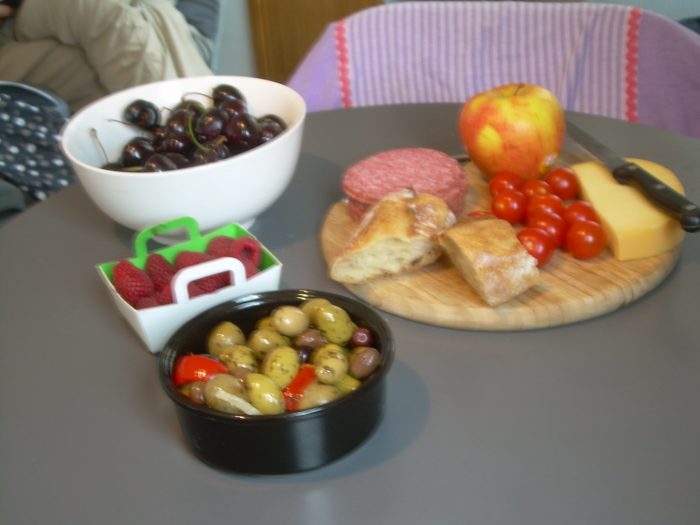
HOME FROM THE MARKET

Posted in Travel | | Tagged , | | 5 Comments

Doug’s “Coming Out” Letter

Here is the text of a letter that appeared in April 21, 2016 edition of the North Coast Journal in which I proclaim (admit?) that I do not accept the present scientific view of reality.

Editor:
In an interesting riff on the insanity defense, my friend Douglas George (mailbox April 14) comes down on one side of a presently unanswerable question. I am here to present the other side.

Douglas argues that what we call “consciousness” is the accidental byproduct of a meaningless evolutionary process. And since evidence now shows that it takes the brain only a half-second to generate a thought that none of us can really be in control of our thoughts or actions. What causes the brain to generate these thoughts? Douglas proposes an inner “robot.”

I want to suggest a radically different approach to the underlying question. I propose that “consciousness” far from being an accidental byproduct exists a priori. That it forms and informs matter be it a rock, a flower, a dust devil or a brain. That it, not some cellular-level mindless robot, generates and is the awareness and the thoughts and emotions flowing through us. This force, I propose, never rests and is endlessly creating. It forms our dreams, our desires and our fears.

It seems we have woken to find ourselves in a classroom. There’s no teacher in charge, no principal down the hall. We are teaching ourselves and what rules exist we make up together. Our task, I would suggest, is to assume ownership of and take responsibility for the astonishing gift that flows in a unique way through each of us. The class is a kindergarten class. Each of us is learning but progress is painfully slow. And here, Douglas and I seem to agree: tolerance, patience, forgiveness, a cookie, the wedge of an orange and an afternoon nap are all helpful.

Posted in Whimsy | | Tagged | | 3 Comments

MASHUP at the Vancouver Art Gallery

On Sunday, March 13, 2016, Nina and I spent much of the afternoon touring a new exhibition at the Vancouver Art Gallery. Titled Mashup: the Birth of Modern Culture, it is the largest single exhibition ever presented at the Gallery filling the display spaces on all four floors. The production presents 371 works of art by 156 artists from Pablo Picasso to Quentin Tarantino, from John Cage to DJ Spooky, from Andy Warhol to Jeff Koons. “Mashup,” as I learned during the afternoon, is a creative process where disparate parts of an art form or culture are combined to form a new creation that ideally comments on the art form or the culture. The earliest items in the show were collages by Picasso and Georges Braque followed by German anti-Nazi Dada and on to T.S. Eliot and William S. Burroughs and past Warhol’s Marilyns and Kennedys and Maos to Frank Gehry and other architects, and up to the present with street culture, hacking and copyright infringement as artistic statements, with musical compositions composed entirely of other musical compositions and a video of cats walking about on piano keys.

A lot of women artists are represented from the earliest periods up to the present: Barbara Kruger’s 2016 site-specific black and white installation that fills the entire first floor entrance is a highlight. Canadian artists are, of course, well represented. My personal favorite is Brian Jungen, a Vancouver artist with First Nations’ ancestry who makes delightful masks and sculptures from Nike shoes and other products. (We once saw a full-sized black tepee that he had constructed from the coverings of leather couches.)

As a whole, though, the experience was both jarring and numbing with clashing sounds, flickering screens, fractured narratives and discordant images all bouncing off one another. Ideally one might visit the exhibition over four days, devoting one day to each floor followed by lunch at the ever-pleasant in-house cafeteria.

Everything we saw was clever, most of it ironic, some of it funny. But rarely was an object beautiful or life-affirming or profound. We found ourselves asking what in all of this will be of interest a century from now. Many of the artists who sought to critique the dominant culture ended up becoming part of it, looking somewhat smarmy in their outsider’s pose as they milked the culture to their advantage. Even those whose works were designed to illustrate the co-opting nature of culture were themselves, it seems, co-opted. We were left with questions. What is the effect on a work of art when the motivation to create is a reaction to something else? Does the wish to make a critical cultural statement through a work of art somehow diminish the work itself? Does an overriding intent to critique a culture, bind the artist to the culture in a way that is corrupting?

The show, which runs through June 12, is certainly worth seeing. Here is a link to the Art Gallery’s website://www.vanartgallery.bc.ca/the_exhibitions/exhibit_mashup.html

Posted in Reviews | | 1 Comment

DISCUSSION POINTS FOR SQUARE

1. Tim and his Environment.

When Tim Holter returns home for lunch at the end of chapter Eleven we learn that the house on Spruce Street that his parents rent from Mr. Elliott is the only home he has ever known. We have no knowledge that he has ever traveled far from this house but as Thoreau famously said about his own journeys-that he had traveled a “good deal in Concord”-we can say as well that Tim has traveled “a good deal” in Stanton Grove. He knows its creeks and trees, its Square, its streets, its older parts and its “new additions.” We get the impression the town is not large and that Tim is never far from the fields and pastures and woods that surround it. And while we do not know the exact location of Stanton Grove, we know that Abe Lincoln may have slept in the City Hall.

Readers may want to discuss how the town, its size and location have helped to shape Tim and his life.


2. Then and Now.

Read on

Posted in Novels | | Tagged , | | Leave a comment